
Technology has always evolved in waves. Some years bring incremental improvements—faster chips, better cameras, more polished software. Other years reshape the direction of the digital world entirely.
2026 sits somewhere in between those two realities.
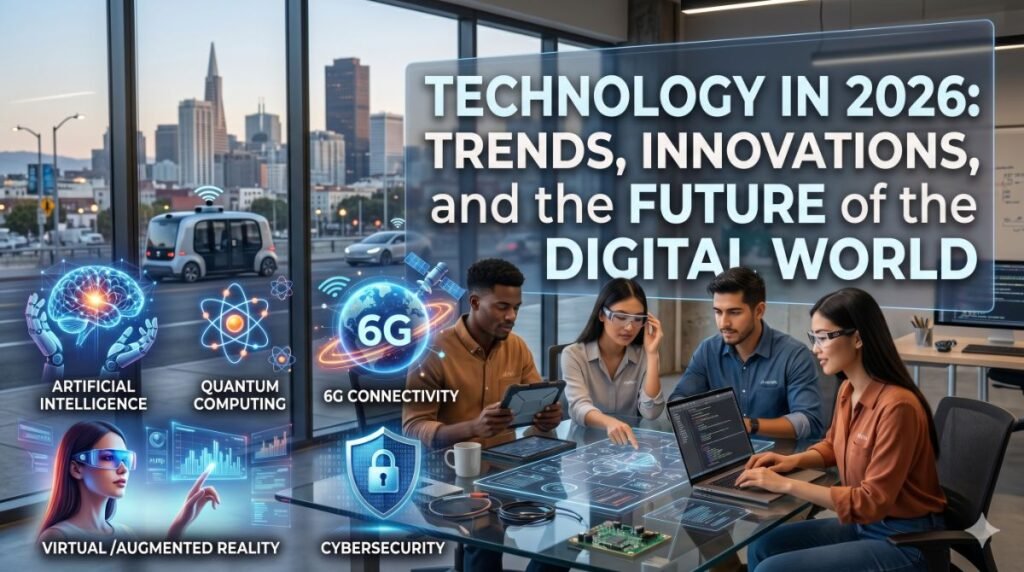
Artificial intelligence is no longer a futuristic concept debated in academic circles. It is embedded in everyday workflows. Automation is redefining how businesses operate. Quantum computing is transitioning from theory to experimentation. Meanwhile, cybersecurity threats have become sophisticated enough to challenge even the most advanced digital defenses.
The result is a technology landscape that feels both exhilarating and uncertain. Innovation is accelerating, yet the questions surrounding ethics, regulation, and long-term impact are growing louder.
So what does Technology in 2026 actually look like on the ground? Not the hype—but the reality shaping businesses, consumers, and the digital economy.
Let’s take a closer look.
Artificial Intelligence Moves From Tool to Infrastructure
For much of the past decade, artificial intelligence was treated as an add-on—an extra layer companies could use to improve efficiency.
That era is over.
In 2026, AI is increasingly becoming the infrastructure beneath modern software systems.
Productivity platforms now rely on AI to summarize documents, generate reports, and automate workflows. Customer support systems deploy AI agents capable of resolving complex issues without human intervention. Even software development itself is partially automated, with developers collaborating with AI copilots that assist in writing and debugging code.
The biggest shift, however, is contextual intelligence.
AI systems today understand not just commands, but context: user behavior, organizational knowledge, and historical data. Instead of responding to prompts alone, they anticipate needs.
Consider how enterprise AI systems now function. Rather than waiting for a user request, they proactively surface insights—flagging operational inefficiencies, predicting supply chain disruptions, or recommending strategic decisions based on real-time data.
In other words, AI is evolving from reactive software to something closer to a digital collaborator.
And businesses that learn how to integrate this capability effectively are seeing enormous gains in productivity.
AI Assistants Are Becoming the Operating Layer of Work
A few years ago, digital assistants were mostly confined to smartphones and smart speakers.
In 2026, AI assistants are beginning to function as an operating layer across work environments.
Open a project management platform, and an AI assistant can automatically draft task assignments. Start a marketing campaign, and an AI tool may generate content variations, analyze audience behavior, and optimize targeting—all in real time.
This shift is driving the next phase of automation and AI adoption across industries.
Finance teams use AI to monitor transaction anomalies. Legal departments rely on AI systems to review contracts in seconds. Media organizations deploy AI tools to assist in research, transcription, and data analysis.
Interestingly, the most successful AI deployments are not replacing human workers entirely. Instead, they augment them.
A journalist might still conduct interviews and shape the narrative of a story—but AI can sift through hundreds of documents, transcripts, and reports in minutes. A developer still designs system architecture—but AI accelerates debugging and testing.
The emerging model is clear: humans provide judgment, creativity, and strategic thinking; AI handles scale, speed, and pattern recognition.
Quantum Computing Edges Toward Practical Use
Quantum computing has spent years trapped between promise and practicality.
For decades, it lived largely in research labs and academic journals. In 2026, that dynamic is slowly shifting.
While large-scale universal quantum computers remain years away, significant progress is being made in next generation computing architectures.
Tech companies and research institutions are now experimenting with hybrid systems that combine classical computing with quantum accelerators. These early implementations are already showing promise in fields such as:
- molecular simulations for pharmaceutical research
- advanced material science
- financial modeling
- complex logistics optimization
Quantum systems excel at solving certain categories of problems—particularly those involving massive combinational possibilities.
Imagine trying to simulate thousands of molecular interactions simultaneously or optimize global shipping routes across millions of variables. Classical computers struggle with such complexity. Quantum systems, in theory, can explore these solution spaces far more efficiently.
The reality today is still experimental. But the direction is unmistakable.
Quantum computing is transitioning from theoretical curiosity to specialized industrial tool.
And once stable, scalable systems emerge, the ripple effects could reshape entire industries.
Cybersecurity in the Future Is Becoming an AI vs AI Battlefield
If technology innovation is accelerating, so are digital threats.
Cybersecurity in the future increasingly resembles an arms race between intelligent systems.
Attackers now use AI tools to automate phishing campaigns, generate highly convincing social engineering messages, and discover vulnerabilities in software systems faster than ever before.
At the same time, defensive technologies are evolving just as rapidly.
Modern security platforms deploy machine learning models that analyze network behavior in real time, identifying anomalies that could signal a breach. These systems monitor millions of events per second, detecting subtle deviations that human analysts might miss.
But the real challenge lies in complexity.
Organizations now operate across cloud environments, mobile devices, remote work systems, and interconnected APIs. Every connection point becomes a potential entry path for attackers.
The cybersecurity strategy of 2026 is therefore shifting toward continuous security intelligence.
Instead of relying solely on perimeter defenses, companies are adopting zero-trust architectures—where every device, user, and system must continuously verify identity and behavior.
Security is no longer a single department’s responsibility. It’s an architectural principle embedded across the entire digital infrastructure.
Robotics and Automation Expand Beyond Factories
For decades, robotics was synonymous with manufacturing.
Rows of robotic arms assembling cars in massive factories.
But robotics in 2026 is escaping the factory floor.
Autonomous delivery robots now navigate urban environments. Agricultural robots monitor crops using computer vision systems that detect disease or nutrient deficiencies. Warehouse automation systems coordinate fleets of robots that move inventory with remarkable efficiency.
Even healthcare is experiencing the impact.
Robotic surgical systems are becoming more precise, assisting surgeons with minimally invasive procedures. Rehabilitation robots help patients regain mobility after injuries or strokes.
One particularly interesting development is the rise of general-purpose service robots.
These systems combine AI perception, mobility, and dexterity to perform varied tasks—from cleaning and maintenance to basic customer interaction.
The technology is still early, but progress is accelerating.
And once robotics reaches a level of reliability suitable for everyday environments, entire industries could experience profound transformation.
Spatial Computing Is Finally Finding Its Audience
For years, augmented reality and virtual reality were often described as “the next computing platform.”
The problem? Most people weren’t convinced.
Headsets were bulky. Applications were limited. The practical use cases felt unclear.
In 2026, however, spatial computing—the blend of AR, VR, and mixed reality—is slowly finding meaningful applications.
Enterprise environments are leading the charge.
Engineers use AR overlays to visualize infrastructure systems while performing maintenance. Medical students train using immersive simulations that replicate real surgical procedures. Architects walk through digital building models before construction begins.
Consumer adoption is also improving as hardware becomes lighter and more capable.
Gaming remains a major driver, but new categories are emerging—virtual collaboration environments, immersive education platforms, and spatial design tools.
The real promise of spatial computing lies in how it changes interaction.
Instead of interacting with information through flat screens, users can manipulate digital objects directly in three-dimensional space.
It’s a subtle shift, but one that could redefine how people engage with digital systems.
Smart Cities and Connected Infrastructure
Urban environments are undergoing their own technological transformation.
The concept of smart cities—once a futuristic vision—has begun materializing through connected infrastructure.
Cities around the world are deploying sensor networks that monitor traffic patterns, air quality, energy consumption, and public transportation systems in real time.
This data allows urban planners to optimize resource usage and improve efficiency.
Traffic signals can adapt dynamically to congestion patterns. Energy grids balance power distribution based on real-time demand. Waste management systems use sensors to optimize collection routes.
For residents, the benefits are often subtle but meaningful.
Shorter commute times. Improved air quality monitoring. Faster emergency response systems.
However, these systems also introduce new concerns.
Massive sensor networks raise questions about data privacy, surveillance, and digital governance. Who controls the data generated by urban infrastructure? How is it protected?
The technology enabling smart cities is advancing rapidly—but the policies guiding its responsible use are still catching up.
Consumer Technology Trends Shaping Daily Life
While enterprise and infrastructure technologies receive much attention, consumer technology trends often reveal where digital culture is heading.
In 2026, several patterns are emerging.
Devices are becoming less visible yet more integrated into daily life.
Smart home ecosystems now coordinate lighting, energy usage, security, and entertainment systems with minimal user interaction. Wearable devices track health metrics with increasing sophistication, monitoring everything from sleep quality to cardiovascular signals.
Even automobiles are evolving into digital platforms.
Modern vehicles now incorporate AI-driven driver assistance systems, connected infotainment environments, and over-the-air software updates that continuously enhance functionality.
Perhaps the most interesting shift is how seamlessly technology blends into routine behavior.
People rarely think about the algorithms recommending music, optimizing navigation routes, or filtering email spam. These systems simply operate in the background.
Technology is no longer something we “use.”
It’s something we live within.
Ethical Questions Are No Longer Optional
With technological progress accelerating, ethical considerations have become impossible to ignore.
Artificial intelligence raises questions about bias, transparency, and accountability. Automation affects labor markets and workforce dynamics. Data-driven systems influence everything from financial decisions to healthcare recommendations.
And then there’s the issue of control.
Who ultimately governs powerful technologies that shape society?
Governments are beginning to introduce regulations around AI safety, algorithmic transparency, and data protection. Tech companies are forming ethics boards and implementing internal oversight mechanisms.
But regulation alone cannot solve these challenges.
Technology development itself must incorporate ethical thinking from the beginning.
Design decisions made today will influence how these systems affect billions of people tomorrow.
And perhaps the most important question facing the tech industry is this:
Can innovation move quickly while still remaining responsible?
The Future of the Digital World
Looking at technology in 2026, one thing becomes clear: we are entering a new phase of digital evolution.
The early internet connected people to information. The mobile revolution connected people to each other. The current wave of emerging tech innovations is connecting intelligence to systems everywhere.
Artificial intelligence, automation, spatial computing, and advanced infrastructure are gradually forming a digital layer that surrounds everyday life.
Some of these changes will unfold quietly—incremental improvements that make daily tasks easier.
Others may reshape entire industries.
But technology’s future is rarely defined solely by invention. It is shaped by how society chooses to adopt, regulate, and integrate these tools into the fabric of everyday life.
The next decade will test that balance.
Innovation will continue pushing forward. The real challenge will be guiding it in a direction that benefits both progress and people.
And if the current trajectory holds, the digital world of the 2030s may look far more intelligent—and interconnected—than anything we imagined only a few years ago.